








403
Sorry!!
Error! We're sorry, but the page you were looking for doesn't exist.
Oil price drop wakeup call for producers says IMF chief
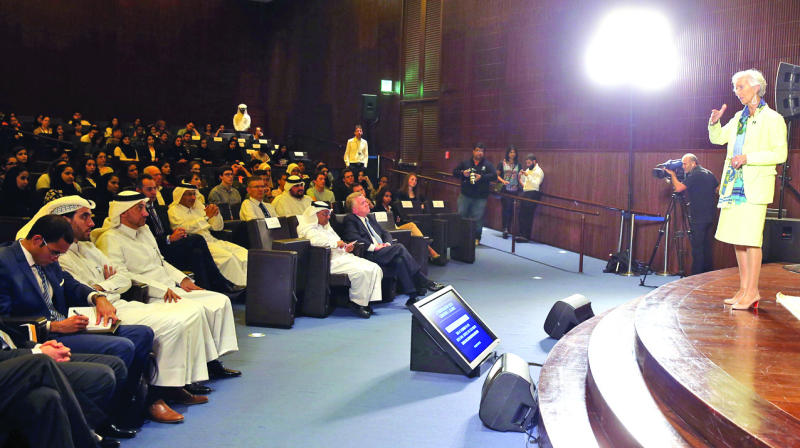
(MENAFN- Arab News) JEDDAH: The global slump in oil prices should be considered as a 'splendid wakeup call' by energy-producing countries for restructuring their economies the head of the International Monetary Fund said Tuesday.
The price of oil has dropped by more than half since the beginning of last year.
Speaking at Georgetown University in Qatar major gas producer Christine Lagarde said those countries reliant on oil and gas revenues had to change to maintain their economic position AFP reported.
"I would say the current situation is a splendid wakeup call to restructure" the agency quoted her as saying.
"In the face of this new situation triggered by the price of the oil which we see as not a short-term phenomenon but a longer-term phenomenon... measures have to be taken" she added.
Lagarde said those measures included finding new sources of revenue and keeping a tight control on spending.
Although not specifically mentioning any countries she also encouraged more private sector involvement.
Lagarde delivered a similar message to ministers of the six Gulf Cooperation Council states Saudi Arabia Bahrain Kuwait Oman and the UAE as well as Qatar on Sunday.
The IMF projects' growth in the GCC states will fall from 3.2 percent this year to 2.7 percent in 2016. It forecasts that export revenues will be $275 billion (256 billion euro) lower this year than in 2014.
Commenting on Lagard's remarks John Sfakianakis Middle East director at Ashmore Group told Arab News that there is little oil producers can do besides what they are doing now to curtail a steeper decline. Since Saudi Arabia and others have decided to opt for market share instead of output cuts there is little that can be done.
'Supply dynamics by conventional and non-conventional (shale) oil producers will determine one side of the price story in years to come. Demand dynamics will determine the other side of the story and where oil prices go from here especially demand from Asia.' Sfakianakis said.
He added: 'It's very hard to tell the direction of oil prices from here especially on the upside. One thing is for sure there is plenty of noise about oil prices too much exaggerated pessimism.
Sami A. Al-Nwaisir chairman of Al-Sami Holding Group said: 'I don't agree with her (Lagarde's) recommendations. She should focus on fixing the IMF before giving advice to others. Also she should implement her recommendations rather than saying something and doing something else as the IMF is doing since the financial crises hit the West 2008 unlike its recommendation in 1997 to the Asian countries.'
'I think what is good for the West is not necessarily good for the East otherwise the West should take the medicine for their current financial crises of high debt unemployment and other financial misery etc.' he added.
Ole Hansen head of commodity strategy at SAXO Bank said: 'The obvious choice would be cutting government expenditure and aligning cost according to revenues. If that is not an option as seen lately with the ballooning Saudi budget deficit for 2016 the alternative will be nursing the price higher by showing intent of adjusting production.'
This however can be a very difficult route to take as the market may see that as a sign of a bottom in the market and start buying accordingly he said. Strong buying would carry the additional risk of taking the price back up to levels where non-OPEC producers will be able to increase production he added.
When asked whether falling prices will affect oil producers' spending plans Hansen said: 'It will have to impact producers spending plans unless they view current low prices as a temporary situation and instead opt to raise capital either by tapping into reserves or by issuing bonds to finance the shortfall.'
The price of oil has dropped by more than half since the beginning of last year.
Speaking at Georgetown University in Qatar major gas producer Christine Lagarde said those countries reliant on oil and gas revenues had to change to maintain their economic position AFP reported.
"I would say the current situation is a splendid wakeup call to restructure" the agency quoted her as saying.
"In the face of this new situation triggered by the price of the oil which we see as not a short-term phenomenon but a longer-term phenomenon... measures have to be taken" she added.
Lagarde said those measures included finding new sources of revenue and keeping a tight control on spending.
Although not specifically mentioning any countries she also encouraged more private sector involvement.
Lagarde delivered a similar message to ministers of the six Gulf Cooperation Council states Saudi Arabia Bahrain Kuwait Oman and the UAE as well as Qatar on Sunday.
The IMF projects' growth in the GCC states will fall from 3.2 percent this year to 2.7 percent in 2016. It forecasts that export revenues will be $275 billion (256 billion euro) lower this year than in 2014.
Commenting on Lagard's remarks John Sfakianakis Middle East director at Ashmore Group told Arab News that there is little oil producers can do besides what they are doing now to curtail a steeper decline. Since Saudi Arabia and others have decided to opt for market share instead of output cuts there is little that can be done.
'Supply dynamics by conventional and non-conventional (shale) oil producers will determine one side of the price story in years to come. Demand dynamics will determine the other side of the story and where oil prices go from here especially demand from Asia.' Sfakianakis said.
He added: 'It's very hard to tell the direction of oil prices from here especially on the upside. One thing is for sure there is plenty of noise about oil prices too much exaggerated pessimism.
Sami A. Al-Nwaisir chairman of Al-Sami Holding Group said: 'I don't agree with her (Lagarde's) recommendations. She should focus on fixing the IMF before giving advice to others. Also she should implement her recommendations rather than saying something and doing something else as the IMF is doing since the financial crises hit the West 2008 unlike its recommendation in 1997 to the Asian countries.'
'I think what is good for the West is not necessarily good for the East otherwise the West should take the medicine for their current financial crises of high debt unemployment and other financial misery etc.' he added.
Ole Hansen head of commodity strategy at SAXO Bank said: 'The obvious choice would be cutting government expenditure and aligning cost according to revenues. If that is not an option as seen lately with the ballooning Saudi budget deficit for 2016 the alternative will be nursing the price higher by showing intent of adjusting production.'
This however can be a very difficult route to take as the market may see that as a sign of a bottom in the market and start buying accordingly he said. Strong buying would carry the additional risk of taking the price back up to levels where non-OPEC producers will be able to increase production he added.
When asked whether falling prices will affect oil producers' spending plans Hansen said: 'It will have to impact producers spending plans unless they view current low prices as a temporary situation and instead opt to raise capital either by tapping into reserves or by issuing bonds to finance the shortfall.'

Legal Disclaimer:
MENAFN provides the
information “as is” without warranty of any kind. We do not accept
any responsibility or liability for the accuracy, content, images,
videos, licenses, completeness, legality, or reliability of the information
contained in this article. If you have any complaints or copyright
issues related to this article, kindly contact the provider above.




Comments
No comment