

403
Sorry!!
Error! We're sorry, but the page you were looking for doesn't exist.
EU- ECB loan offer meets weak demand in sign of recovery risks


(MENAFN- Gulf Times) The European Central Bank attracted just ‚¬15.5bn ($17.4bn) of demand from lenders for the latest round of its long-term loan programme, in a sign that weak investment may hinder the euro-area recovery.
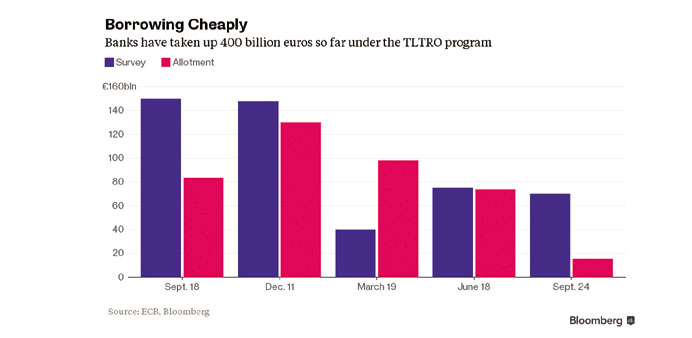
The take-up was lower than all the estimates in a Bloomberg News survey, which ranged from ‚¬35bn to ‚¬120bn. Banks borrowed ‚¬74bn in a similar operation in June.
The euro area is struggling to boost investment as its fragile recovery runs into the headwinds of a China-led emerging-market slowdown. The TLTROs are an indication of banks' willingness to bet on Europe's economic upswing.
"It's disappointing whatever way you turn it and a reminder that the corporate sector is still under a lot of strain," said Anatoli Annenkov, senior economist at Societe Generale in London.
"It fits with our idea of how investment will develop over the coming year, but not with the ECB's hope that it will become part of the recovery."
While the euro-area economy expanded 0.4% in the second quarter, that was driven by private consumption and net trade. Investment fell 0.5% from the first three months of the year, when it expanded 1.4%.
ECB President Mario Draghi announced the Targeted Longer-Term Refinancing Operations in June 2014 as one of several measures intend to revive the economy through loans to small and medium-sized enterprises and help boost inflation.
Under current operations, banks can borrow as much as three times their net lending to companies and households, excluding mortgages, over a set period. The loans are offered at the main refinancing rate, currently 0.05%, and mature in September 2018.
Italian banks have been the main beneficiaries of the cheap loans, with Intesa Sanpaolo and UniCredit leading a list of institutions that have disclosed their borrowings before yesterday's operation.
"We have evidence that the ones that accessed most this programme are also the ones that lent more to the SME's and are also the ones where the interest rates, the lending rates went down most," Draghi told European lawmakers on Wednesday. "So there are interesting correlations between our programmes and their effectiveness."
Goldman Sachs Group said in a note before the TLTRO that the attractiveness of the programme has declined as funding conditions normalise and banks revert to market financing. It forecast a take-up of ‚¬60bn to ‚¬80bn in the current round, and cut its estimate for the total programme to between ‚¬420bn and ‚¬495bn from its earlier estimate of ‚¬520bn to 610bn.
"A lower take-up at the fifth operation is not unexpected, but the magnitude of the drop compared to June's level is a surprise," said Ken Wattret, an economist at BNP Paribas in London. "The latest TLTRO take-up is a quarter of just one month's average volume of purchases under" quantitative easing.
The TLTROs are dwarfed by the ‚¬60bn-a-month bond-buying programme the ECB started in March, which has helped flood the 19-nation currency bloc with cash. Excess liquidity in the euro area has jumped to more than ‚¬470bn from as low as ‚¬71bn in November.
In his testimony at the European Parliament in Brussels, Draghi defended the loan programme nonetheless.
"Our monetary-policy measures in place, including the TLTROs, continue to have a favourable impact on the cost and availability of credit for firms and households," he said.
"The sustained decline in the cost of borrowing is strengthening domestic demand, by supporting durable-goods consumption and stimulating investment particularly by small and medium-sized businesses. This is making the euro-area economy more resistant to external shocks."
The take-up was lower than all the estimates in a Bloomberg News survey, which ranged from ‚¬35bn to ‚¬120bn. Banks borrowed ‚¬74bn in a similar operation in June.
The euro area is struggling to boost investment as its fragile recovery runs into the headwinds of a China-led emerging-market slowdown. The TLTROs are an indication of banks' willingness to bet on Europe's economic upswing.
"It's disappointing whatever way you turn it and a reminder that the corporate sector is still under a lot of strain," said Anatoli Annenkov, senior economist at Societe Generale in London.
"It fits with our idea of how investment will develop over the coming year, but not with the ECB's hope that it will become part of the recovery."
While the euro-area economy expanded 0.4% in the second quarter, that was driven by private consumption and net trade. Investment fell 0.5% from the first three months of the year, when it expanded 1.4%.
ECB President Mario Draghi announced the Targeted Longer-Term Refinancing Operations in June 2014 as one of several measures intend to revive the economy through loans to small and medium-sized enterprises and help boost inflation.
Under current operations, banks can borrow as much as three times their net lending to companies and households, excluding mortgages, over a set period. The loans are offered at the main refinancing rate, currently 0.05%, and mature in September 2018.
Italian banks have been the main beneficiaries of the cheap loans, with Intesa Sanpaolo and UniCredit leading a list of institutions that have disclosed their borrowings before yesterday's operation.
"We have evidence that the ones that accessed most this programme are also the ones that lent more to the SME's and are also the ones where the interest rates, the lending rates went down most," Draghi told European lawmakers on Wednesday. "So there are interesting correlations between our programmes and their effectiveness."
Goldman Sachs Group said in a note before the TLTRO that the attractiveness of the programme has declined as funding conditions normalise and banks revert to market financing. It forecast a take-up of ‚¬60bn to ‚¬80bn in the current round, and cut its estimate for the total programme to between ‚¬420bn and ‚¬495bn from its earlier estimate of ‚¬520bn to 610bn.
"A lower take-up at the fifth operation is not unexpected, but the magnitude of the drop compared to June's level is a surprise," said Ken Wattret, an economist at BNP Paribas in London. "The latest TLTRO take-up is a quarter of just one month's average volume of purchases under" quantitative easing.
The TLTROs are dwarfed by the ‚¬60bn-a-month bond-buying programme the ECB started in March, which has helped flood the 19-nation currency bloc with cash. Excess liquidity in the euro area has jumped to more than ‚¬470bn from as low as ‚¬71bn in November.
In his testimony at the European Parliament in Brussels, Draghi defended the loan programme nonetheless.
"Our monetary-policy measures in place, including the TLTROs, continue to have a favourable impact on the cost and availability of credit for firms and households," he said.
"The sustained decline in the cost of borrowing is strengthening domestic demand, by supporting durable-goods consumption and stimulating investment particularly by small and medium-sized businesses. This is making the euro-area economy more resistant to external shocks."

Legal Disclaimer:
MENAFN provides the
information “as is” without warranty of any kind. We do not accept any
responsibility or liability for the accuracy, content, images, videos,
licenses, completeness, legality, or reliability of the information
contained in this article. If you have any complaints or copyright issues
related to this article, kindly contact the provider above.
Comments
No comment