


Germany- Comet probe Philae has fallen silent


(MENAFN- Arab News) PARIS: Europe's comet-riding robot lab Philae has fallen 'silent' said ground controllers Monday who feared it may have shifted on the rough alien surface out of radio range.
The latest data suggested the probe perched on a comet streaking toward the Sun may no longer be in line of contact with its orbiting mothership Rosetta which relays its messages to Earth they said.
'In the telemetry received we have observed signs that Philae could have moved and that its antennas are thus perhaps more concealed or their orientation might have changed' said project leader Stephan Ulamec of the German Aerospace Center (DLR).
The washing machine-sized lander may have been dislodged by the gas and dust blasting from Comet 67P/Churyumov-Gerasimenko as it draws ever closer to the Sun.
The data also indicated one of Philae's two transmission units appeared not to be working properly and a receiver was damaged said a statement from the European Space Agency (ESA) which described the lander's status as 'uncertain.'
'At the moment we have some concerns about this' DLR spokeswoman Manuela Braun told AFP. 'We are trying to understand.'
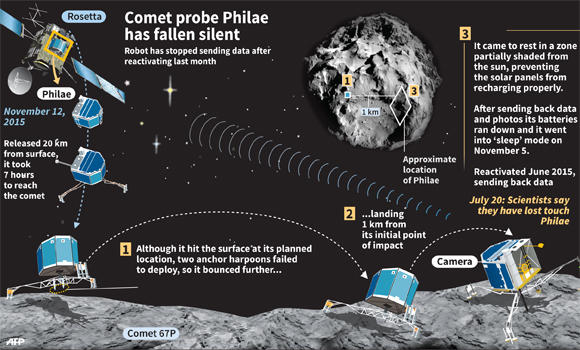
Philae which touched down on 67P on Nov. 12 last year went into hibernation three days later and woke up again on June 13 for intermittent communications with Earth.
It has since called home eight times the last on July 9 when critical data was uploaded from Philae's prodding and probing of its alien home.
But since then the robot probe has gone 'back to 'silent mode'' said the DLR statement.
Efforts are being made to contact Philae possibly by adjusting Rosetta's orbit to try and find a better connection.
But moving the lander itself is not an option for now.
'At the moment we don't move it because we don't want to irritate it' said Braun. 'We want to understand the situation before changing anything which might result in a worse situation.'There has been an added complication: Rosetta has had to be moved into a further orbit as its star-reading navigation system was being confused by the dust particles streaming out of the comet.
Philae touched down on Nov. 12 last year after a 10-year journey piggybacking on Rosetta.
The landing was bumpy the tiny lab bounced several times on the craggy surface before ending up near a crater rim on uneven terrain deprived of sunlight to replenish its battery.
Philae had enough onboard power to send home data from about 60 hours of tests conducted with eight of its 10 instruments before going into standby mode on Nov. 15.
The latest data suggested the probe perched on a comet streaking toward the Sun may no longer be in line of contact with its orbiting mothership Rosetta which relays its messages to Earth they said.
'In the telemetry received we have observed signs that Philae could have moved and that its antennas are thus perhaps more concealed or their orientation might have changed' said project leader Stephan Ulamec of the German Aerospace Center (DLR).
The washing machine-sized lander may have been dislodged by the gas and dust blasting from Comet 67P/Churyumov-Gerasimenko as it draws ever closer to the Sun.
The data also indicated one of Philae's two transmission units appeared not to be working properly and a receiver was damaged said a statement from the European Space Agency (ESA) which described the lander's status as 'uncertain.'
'At the moment we have some concerns about this' DLR spokeswoman Manuela Braun told AFP. 'We are trying to understand.'
Philae which touched down on 67P on Nov. 12 last year went into hibernation three days later and woke up again on June 13 for intermittent communications with Earth.
It has since called home eight times the last on July 9 when critical data was uploaded from Philae's prodding and probing of its alien home.
But since then the robot probe has gone 'back to 'silent mode'' said the DLR statement.
Efforts are being made to contact Philae possibly by adjusting Rosetta's orbit to try and find a better connection.
But moving the lander itself is not an option for now.
'At the moment we don't move it because we don't want to irritate it' said Braun. 'We want to understand the situation before changing anything which might result in a worse situation.'There has been an added complication: Rosetta has had to be moved into a further orbit as its star-reading navigation system was being confused by the dust particles streaming out of the comet.
Philae touched down on Nov. 12 last year after a 10-year journey piggybacking on Rosetta.
The landing was bumpy the tiny lab bounced several times on the craggy surface before ending up near a crater rim on uneven terrain deprived of sunlight to replenish its battery.
Philae had enough onboard power to send home data from about 60 hours of tests conducted with eight of its 10 instruments before going into standby mode on Nov. 15.

Legal Disclaimer:
MENAFN provides the
information “as is” without warranty of any kind. We do not accept
any responsibility or liability for the accuracy, content, images,
videos, licenses, completeness, legality, or reliability of the information
contained in this article. If you have any complaints or copyright
issues related to this article, kindly contact the provider above.


Comments
No comment