


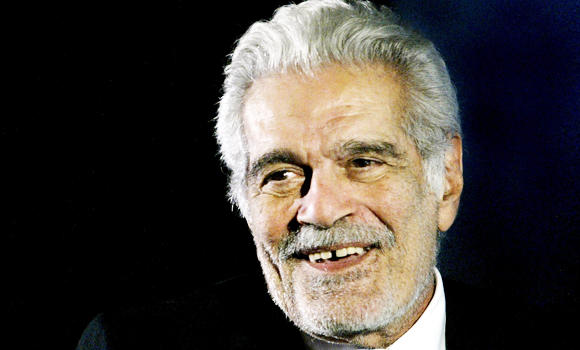
Actor Omar Sharif 83 dies in Cairo


(MENAFN- Arab News) CAIRO: Actor Omar Sharif best known for his title role as Doctor Zhivago in the Oscar-winning film has died in Cairo Egyptian state television said. He was 83.
The BBC also reported his death citing his agent.
In May Sharif's agent confirmed the actor who played a wide range of dashing and dignified characters while building a reputation as an expert bridge player had been suffering from Alzheimer's disease.
Sharif was one of the few Arab actors to make it big in Hollywood. He won international fame and an Oscar-nomination for best supporting actor for his role in the 1962 film 'Lawrence of Arabia' with Peter O'Toole.
Born as Michel Shalhoub on April 10 1932 to a wealthy family in Alexandria Egypt Sharif grew interested in acting while studying mathematics and physics at university in Cairo.
But he worked in his father's timber business for several years before realizing his dream with a role in an Egyptian movie 'The Blazing Sun' in 1954 opposite the Middle East's biggest female star Faten Hamama.
Raised as a Roman Catholic Sharif converted to Islam and married Hamama in 1955 taking on his new name. They had a son Tarek who played Yuri in 'Doctor Zhivago' at age 8 but the couple divorced in 1974. Despite Sharif's image as an eligible bachelor he did not remarry saying he never fell in love with another woman. 'I've always been extremely lucky in my life' he told Al Jazeera television in 2007 while reflecting on how he 'might have been happier' staying in Egypt where he had a contented family life and already was a star.
'Even for 'Lawrence of Arabia' I didn't ask to be an international actor' he said. 'When going to America and becoming famous it gave me glory but it gave me loneliness also and a lot of missing my own land and my own people and my own family.'
After 'The Blazing Sun' Sharif had appeared in several other Egyptian films before starring in 1958 in the French love story 'Goha' which was seen in many English-speaking countries.
With more Egyptian movies to his credit he was picked by director David Lean to play Sherif Ali in the 1962 epic 'Lawrence of Arabia' alongside O'Toole Alec Guinness and Anthony Quinn.
His portrayal of Lawrence's friend earned Sharif an Academy Award nomination for best supporting actor and a contract with Columbia Studios. It won him renewed admiration when the film was restored and re-released in 1989.
After 'Lawrence of Arabia' Sharif played Sophia Loren's Armenian husband in 'The Fall of the Roman Empire' a Spanish priest in 'Behold a Pale Horse' Ingrid Bergman's Yugoslav lover in 'The Yellow Rolls-Royce' all in 1964 and the title character in 'Genghis Khan' in 1965. Then came the title role in 'Doctor Zhivago' the story of a physician and poet caught up in the Russian revolution. Despite criticism the film and Sharif were a hit.
Confirming his flexibility Sharif next played a Nazi officer in 'The Night of the Generals' a Jewish gambler in 'Funny Girl' opposite Barbra Streisand and an Austrian prince in 'Mayerling.' In 1969 he was a Mexican villain in 'Mackenna's Gold' an Italian lawyer in 'The Appointment' and a Latin revolutionary in 'Che!'
But only 'Funny Girl' was a success and Sharif came under increasing criticism for stiff and uninspired performances.
On the set of 'Mayerling' he was asked about his approach to playing Prince Rudolph.
'I haven't a clue. I'm not that kind of actor' he said. 'I play Rudolph like I play all my parts. Rudolph is me. I don't give a damn about how his mind works. All I care about is getting to the studio on time and remembering my lines.'
Legal Disclaimer:
MENAFN provides the
information “as is” without warranty of any kind. We do not accept any
responsibility or liability for the accuracy, content, images, videos,
licenses, completeness, legality, or reliability of the information
contained in this article. If you have any complaints or copyright issues
related to this article, kindly contact the provider above.


Comments
No comment