

For Dh3 a peek into the Dubai of yesteryears


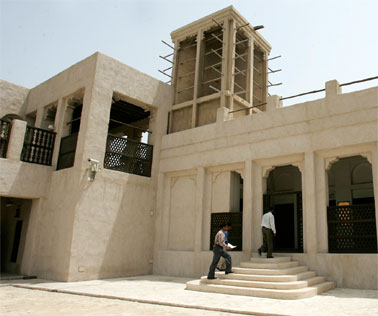
The Shaikh Saeed Al Maktoum House at the Shindagah Village. -File photos
Fat chance of seeing anyone at high noon as you emerge from the underground exit of gate 4 Al Ghubaiba Metro station. It’s hot it’s Ramadan and tourists this time of the year prefer “the beach ... City Centre ... The Dubai Mall” — anything that is the opposite of heritage says Mohammed Al Fattan Manager Shaikh Saeed Al Maktoum House the museum in the Shindagah village.
The Ghubaiba Metro Station it has to be noted is beautifully designed possibly the nicest in Dubai with Middle Eastern architecture to blend in with the village surroundings. The platforms have arched windows with filigree work yellow stone and portraits of men in a bygone era with leather satchels and falcons instead of laptop bags for accessories.
The exit of the museum where a camel occupies a place of pride.
But the village itself on a weekday afternoon in June is deader than the skin on a camel’s hoof. As you exit you also see a camel a welcome if trite background for most ‘travel’ photographs.
Deserted stretch
By 1pm on a Sunday afternoon only 14 people had entered the museum house.
The entrance fee is Dh3. For children it’s Dh1. The watchman Bikram shows me the ticket stubs — all people who’ve dismounted off Big Bus Tours. The tickets are marked ‘Company’.
Al Fattan says: “Very few tourists this season. In winter we got about 7800 but summer maybe 2500 to 3000”. He makes a phone call to find out how many visitors there were 2014. “60 971 people in 2014 visited the Shaikh Saeed Al Maktoum House”.
Not very much compared to the numbers that pass through the Dubai International Airport.
History recap
The Shaikh Saeed Al Maktoum House has been around since 1896. During the era of the late Shaikh Maktoum bin Hasher Al Maktoum this house was both the residence of the ruler as well as the seat of administration. Al Maktoum wing has pictures of the ruling family of the ancestry in chronology and well documented images of foreign dignitaries who visited from the Gulf and Arab countries.
There’s a sweet father-son shot of ruler and future ruler in his father’s lap: Shaikh Rashid bin Saeed Al Maktoum with his son His Highness Shaikh Mohammed bin Rashid Al Maktoum Vice-President and Prime Minister of the UAE and Ruler of Dubai (circa 1954). They don’t let you take photographs in this wing as also in the social and marine wings.
Vivid captions
In the social wing the caption of one black and white photograph of a gentleman smiling at the camera became a favourite instantly: ‘A seller of bits and pieces in Shindagah’.
When you can go with bits ad pieces why get down to the specifics. There were other thoroughly enlightening details of some stunning images.
‘A swarm of locusts over Dubai 1953’; ‘The key to success in falconry is the relationship between falcon and falconer’; ‘Camel Caravan bringing charcoal to Dubai Souq’; ‘A young man takes a nap at his father’s shop’. There were plenty others. Some to the point: ‘The fish seller’; ‘The Dates Seller’; ‘The Baker’; ‘The letter reader; ‘karani’; ‘Deira Souq 1948’; ‘Building oil platforms 1968’; ‘Barasti homes and coffee shops in Shindagah 1951’ and an especially lovely photograph large black and white of ‘The bookbinder’ – another smiling portrait.
In the captions at the social life wing Bedouin is spelt with a ‘w’ so we have ‘A bedowin girl with her camel’ and ‘A bedowin holding a spiny-tailed lizard ‘Dhabb’’.
The photographs aren’t all marked with a date stamp. Some just exist outside time: Two laughing men one soaked. Underneath the caption: ‘A father douches his son with well water’.
Marine life
The most illuminating section Marine Life has on display besides a bunch of other memorabilia scoops (possibly made of copper) that were used for handling pearls. There are also pictures and miniatures of ships of varying sizes — the al sambouk (for long journeys) the al jalbout (presumably shorter journeys) and al samaa (kind of like trawlers) used to board and head out into the Arabian Ocean.
Along with the scoops you can peer into the glass case that holds small sieves for small pearls medium sieves for medium-sized pearls and the largest pearls – say of 10 Methqal scale naturally got the largest scoop the sieve with the largest gaps.
The measurements grow from Ana to Ratti to Methqal with four grades. So there is 1 Ana 2 Ana then ¼ Rati and ½ Rati. Three sizes then of Rattis — 1 2 and 3. The fourth Rati is ¼ Methqal. Then the Methqal sizes: half 1 2 and 5. You have to see the chart and the varying sizes for yourself to appreciate entirely what it must have meant to live and breathe a tradition of pearls.
There are photos of oysters split open and encasing glistening white dots — pearls of course. And there are pictures of ‘Diver in cotton diving suit to protect him from jellyfish stings’.
Shame that only some 61000 people a year make the effort to go see this stuff.
The more popular historic tours become especially with the tourists the more authorities will do to preserve and keep it safe.

Legal Disclaimer:
MENAFN provides the
information “as is” without warranty of any kind. We do not accept any
responsibility or liability for the accuracy, content, images, videos,
licenses, completeness, legality, or reliability of the information
contained in this article. If you have any complaints or copyright issues
related to this article, kindly contact the provider above.
Comments
No comment