

403
Sorry!!
Error! We're sorry, but the page you were looking for doesn't exist.
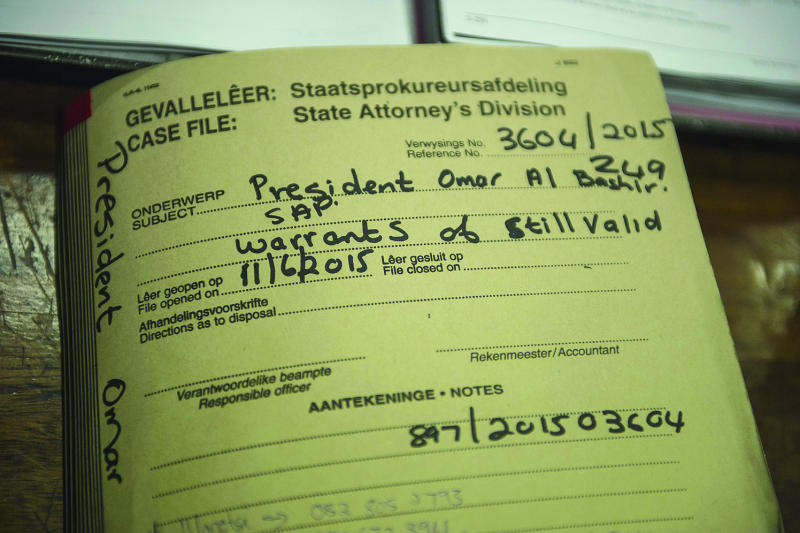
S. Africa given 7 days to explain why it let Bashir go


(MENAFN- Arab News) JOHANNESBURG: The South African government has a week to explain to judges why it defied a court order barring the Sudanese President Omar Al-Bashir from leaving the country.
Bashir flew out of South Africa on Monday before the end of the African Union leaders' summit despite an earlier ruling blocking him from leaving.
A court Monday ordered the government to disclose why he was allowed to leave in a ruling which criticised the authorities' action as inconsistent with the constitution.
Bashir who is wanted by the International Criminal Court (ICC) for genocide and crimes against humanity in Darfur arrived in South Africa on Saturday to attend the AU summit prompting a court bid by a rights group to have him arrested.
The South African government said it would investigate the circumstances surrounding Bashir's departure on his presidential jet that took off from a military base.
'We will also comply with the court order relating to submission of an affidavit outlining these circumstances' the government said in a statement.
A constitutional law expert warned that South Africa's decision to defy the court order on Bashir did not bode well for the country's justice system.
'When a democratically elected government flouts the orders of a court it undermines public confidence in the courts and undermines the legal system as a whole' said Pierre de Vos who is based at the University of Cape Town.
De Vos said the decision 'constitutes a deliberate pre-meditated act of contempt of court.'
Bashir's presence overshadowed the summit held in Johannesburg placing the South African government under scrutiny.
South Africa is a signatory of The Hague-based ICC and has come under global criticism for failing to arrest Bashir who has evaded justice since his indictment in 1999.
The ICC indictments relate to the western Sudanese region of Darfur which erupted into conflict in 2003 when black insurgents rose up against Bashir's Arab-dominated government protesting they were marginalized. 'The decision by South Africa not to arrest al-Bashir amplifies the tension between the AU and the ICC which has been simmering for some time now' according to Netsanet Belay Amnesty International Africa Research and Advocacy Director.
Belay said the organisation had hoped that South Africa 'being a leading democracy would execute its obligation and arrest Bashir...we had high expectations.'
'However we are comforted by the progressive ruling of the court.'
Since his indictment Bashir has mostly travelled to countries that have not joined the ICC and South Africa had previously stated that it would arrest him.
Bashir flew out of South Africa on Monday before the end of the African Union leaders' summit despite an earlier ruling blocking him from leaving.
A court Monday ordered the government to disclose why he was allowed to leave in a ruling which criticised the authorities' action as inconsistent with the constitution.
Bashir who is wanted by the International Criminal Court (ICC) for genocide and crimes against humanity in Darfur arrived in South Africa on Saturday to attend the AU summit prompting a court bid by a rights group to have him arrested.
The South African government said it would investigate the circumstances surrounding Bashir's departure on his presidential jet that took off from a military base.
'We will also comply with the court order relating to submission of an affidavit outlining these circumstances' the government said in a statement.
A constitutional law expert warned that South Africa's decision to defy the court order on Bashir did not bode well for the country's justice system.
'When a democratically elected government flouts the orders of a court it undermines public confidence in the courts and undermines the legal system as a whole' said Pierre de Vos who is based at the University of Cape Town.
De Vos said the decision 'constitutes a deliberate pre-meditated act of contempt of court.'
Bashir's presence overshadowed the summit held in Johannesburg placing the South African government under scrutiny.
South Africa is a signatory of The Hague-based ICC and has come under global criticism for failing to arrest Bashir who has evaded justice since his indictment in 1999.
The ICC indictments relate to the western Sudanese region of Darfur which erupted into conflict in 2003 when black insurgents rose up against Bashir's Arab-dominated government protesting they were marginalized. 'The decision by South Africa not to arrest al-Bashir amplifies the tension between the AU and the ICC which has been simmering for some time now' according to Netsanet Belay Amnesty International Africa Research and Advocacy Director.
Belay said the organisation had hoped that South Africa 'being a leading democracy would execute its obligation and arrest Bashir...we had high expectations.'
'However we are comforted by the progressive ruling of the court.'
Since his indictment Bashir has mostly travelled to countries that have not joined the ICC and South Africa had previously stated that it would arrest him.

Legal Disclaimer:
MENAFN provides the
information “as is” without warranty of any kind. We do not accept any
responsibility or liability for the accuracy, content, images, videos,
licenses, completeness, legality, or reliability of the information
contained in this article. If you have any complaints or copyright issues
related to this article, kindly contact the provider above.
Comments
No comment