


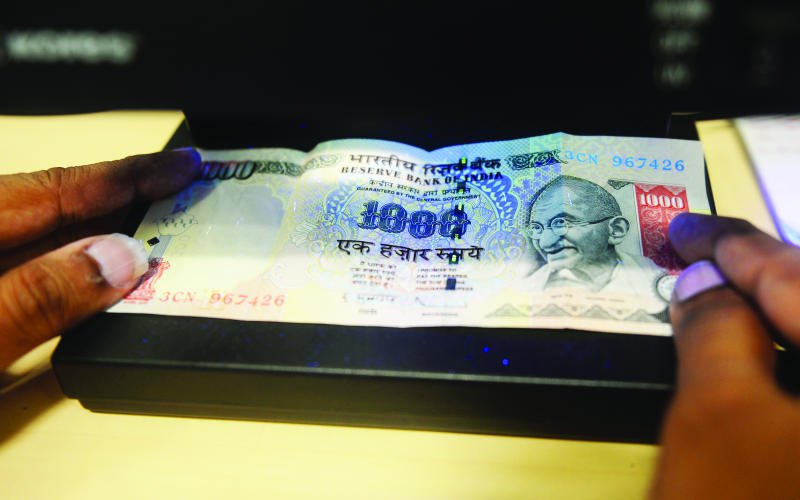
It's time for India to rethink the rupee


(MENAFN- Arab News) NEW DELHI: One of the most dramatic signs of a shift in investor sentiment about India has been the turnaround in the rupee's fortunes.
In April as nervous foreign investors began to withdraw money after a controversy over retrospective taxes and snags in Prime Minister Narendra Modi's reform efforts the currency dropped to a three-month low against the US dollar. It's hovered around that level since.
On the defensive both the government and the Reserve Bank of India insist the rupee's slide is temporary. It shouldn't be.
In India a weak rupee has traditionally been viewed as a sign of political weakness.
Raghuram Rajan RBI governor counts as a major success the recovery of the rupee from freefall in September 2013 just as he took office and at a time when confidence in the previous government had reached an all-time low.
After Modi swept to power in May 2014 the rupee continued to strengthen because of a huge inflow of foreign institutional investment.
Modi remains a forceful advocate of a stronger rupee which he seems to think equates to national strength.
One can see why. Historically unlike many East Asian countries India never adopted an export-oriented economic strategy so had little incentive to maintain a weak currency.
As India's dependence on imports particularly oil increased a stronger exchange rate also helped to contain inflationary pressures.
On the other hand steep devaluation of the currency is associated with two episodes of national humiliation the balance of payments crises that struck in the mid-1960s and again in the early 1990s.
The calculus for India has changed however.
Of course stability in the exchange rate remains crucial: Volatility vitiates the business environment.
But that shouldn't be confused with the currency's level.
Exports of goods and services are now crucial for India's growth accounting for 25 percent of India's GDP in 2013. Modi wants to transform India into a base for manufacturers both foreign and local.
Yet exporters face challenges that many of their competitors based in other Asian countries don't from terrible infrastructure to red tape to an inordinately complex tax regime.
They can ill afford the burden of a strong exchange rate too. Between April 2014 and March 2015 the rupee depreciated just 4.5 percent against the US dollar.
In the same period the dollar appreciated against other major currencies in far greater magnitudes: 24 percent against the euro 16 percent against the yen and 14 percent against the British pound.
The damage is already obvious. According to government data exports fell for the fifth month in a row in April 2015. At 21 percent the plunge in March was the steepest fall in five-and-a-half years. The only reason this hasn't provoked any immediate alarm is because imports are contracting too largely because of lower crude oil prices. The trade deficit which reached $10.99 billion in April is manageable but still significant.
By rights the rupee should depreciate by a certain percentage every year just to make up the difference between inflation in India and in key countries like the US.
That means it should certainly stand at a lower value against the dollar than in August-September 2013 when the rupee fell dramatically from a level of around 60 to a dollar to close to 70. Instead it remains relatively strong at 63.6 to a dollar.
India's export elasticity is widely acknowledged a fall in the exchange rate does boost exports both in goods and particularly in services like information technology.
While imports will also become more expensive low oil prices should continue to cushion the blow.
Also a weaker currency will make the import of gold more expensive and should deter Indians from spending more on what's essentially an unproductive asset.
Even as overall imports have fallen the value of gold imported has risen in recent months.
On May 18 India's Commerce Minister broke ranks welcoming the rupee's recent weakness.
She hedged a bit by saying the currency should stabilize at a 'realistic market rate.'
In fact Modi and Rajan could justifiably let the rupee fall even below the market rate at least while global oil and commodity prices remain low.
If India really wants to grow into an export power it needs to start acting like one.
Dhiraj Nayyar is a journalist in New Delhi.
(c) 2015 Bloomberg News
In April as nervous foreign investors began to withdraw money after a controversy over retrospective taxes and snags in Prime Minister Narendra Modi's reform efforts the currency dropped to a three-month low against the US dollar. It's hovered around that level since.
On the defensive both the government and the Reserve Bank of India insist the rupee's slide is temporary. It shouldn't be.
In India a weak rupee has traditionally been viewed as a sign of political weakness.
Raghuram Rajan RBI governor counts as a major success the recovery of the rupee from freefall in September 2013 just as he took office and at a time when confidence in the previous government had reached an all-time low.
After Modi swept to power in May 2014 the rupee continued to strengthen because of a huge inflow of foreign institutional investment.
Modi remains a forceful advocate of a stronger rupee which he seems to think equates to national strength.
One can see why. Historically unlike many East Asian countries India never adopted an export-oriented economic strategy so had little incentive to maintain a weak currency.
As India's dependence on imports particularly oil increased a stronger exchange rate also helped to contain inflationary pressures.
On the other hand steep devaluation of the currency is associated with two episodes of national humiliation the balance of payments crises that struck in the mid-1960s and again in the early 1990s.
The calculus for India has changed however.
Of course stability in the exchange rate remains crucial: Volatility vitiates the business environment.
But that shouldn't be confused with the currency's level.
Exports of goods and services are now crucial for India's growth accounting for 25 percent of India's GDP in 2013. Modi wants to transform India into a base for manufacturers both foreign and local.
Yet exporters face challenges that many of their competitors based in other Asian countries don't from terrible infrastructure to red tape to an inordinately complex tax regime.
They can ill afford the burden of a strong exchange rate too. Between April 2014 and March 2015 the rupee depreciated just 4.5 percent against the US dollar.
In the same period the dollar appreciated against other major currencies in far greater magnitudes: 24 percent against the euro 16 percent against the yen and 14 percent against the British pound.
The damage is already obvious. According to government data exports fell for the fifth month in a row in April 2015. At 21 percent the plunge in March was the steepest fall in five-and-a-half years. The only reason this hasn't provoked any immediate alarm is because imports are contracting too largely because of lower crude oil prices. The trade deficit which reached $10.99 billion in April is manageable but still significant.
By rights the rupee should depreciate by a certain percentage every year just to make up the difference between inflation in India and in key countries like the US.
That means it should certainly stand at a lower value against the dollar than in August-September 2013 when the rupee fell dramatically from a level of around 60 to a dollar to close to 70. Instead it remains relatively strong at 63.6 to a dollar.
India's export elasticity is widely acknowledged a fall in the exchange rate does boost exports both in goods and particularly in services like information technology.
While imports will also become more expensive low oil prices should continue to cushion the blow.
Also a weaker currency will make the import of gold more expensive and should deter Indians from spending more on what's essentially an unproductive asset.
Even as overall imports have fallen the value of gold imported has risen in recent months.
On May 18 India's Commerce Minister broke ranks welcoming the rupee's recent weakness.
She hedged a bit by saying the currency should stabilize at a 'realistic market rate.'
In fact Modi and Rajan could justifiably let the rupee fall even below the market rate at least while global oil and commodity prices remain low.
If India really wants to grow into an export power it needs to start acting like one.
Dhiraj Nayyar is a journalist in New Delhi.
(c) 2015 Bloomberg News

Legal Disclaimer:
MENAFN provides the
information “as is” without warranty of any kind. We do not accept
any responsibility or liability for the accuracy, content, images,
videos, licenses, completeness, legality, or reliability of the information
contained in this article. If you have any complaints or copyright
issues related to this article, kindly contact the provider above.


Comments
No comment