










403
Sorry!!
Error! We're sorry, but the page you were looking for doesn't exist.
'Islamic fund industry' an alternative model of financial investment
(MENAFN- Arab News) JEDDAH: Saudi Arabian mutual fund industry maintains the largest position in Middle East North Africa (MENA) region in terms of asset under management. The industry has shown a remarkable growth of assets under management over the past couple of years.
But the number of subscriber by ending first quarter 2015 is reduced to 242802 subscribers which are lowest in ten years a decrease of 5.3 percent on YoY basis. The highest reported subscribers were 568284 at end of year 2005 onward subscribers to the Saudi investment funds reduced consecutively the Saudi Arabian Monetary Agency said in a report.
Is there a change in investors' preferences?
The reason for decline is direct access to the traders and investors for trading in local as well as in international stocks and commodities more facilities and analysis are available. Trading platforms are introduced by local brokers to trade directly in stocks in local and international markets.
However Mutual funds offer a number of advantages to investors in comparison to equity investments e.g. diversification portfolios under professional management lower entry level economies of scale and minimization of losses.
Whereas investing in equities has a risk-reward association with it. Equities are more volatile or risky and in turn offer attractive returns.
Perhaps attractive returns spurred investors to change their preferences from risk-aversion to risk-seeking.
However a significant increase in the number of Shariah-compliant funds suggests a robust demand for Islamic investing also.
'As with the broader Islamic finance industry the Islamic funds has grown to become an increasingly substantial segment within the global financial markets and has gained significant interest as a viable and efficient alternative model of financial investment' Abdul Rahman Mohammed Al-Baker executive director of Financial Institutions Supervision at the Central Bank of Bahrain (CBB) said on Monday during the 11th annual edition of the World Islamic Funds and Financial Markets (WIFFMC).
Global Islamic funds under management expected to reach $77 billion by 2019. Demand for Islamic funds projected to reach $185 billion by 2019. Malaysia and Saudi Arabia hold 69 percent of total Islamic funds under management. Sukuks and equities are the most preferred asset types for investors and asset managers projected in a Global Islamic Asset Management Outlook Report by Thomson Reuters.
The Saudi mutual fund industry is divided into Islamic Shariah-compliant and conventional types where 178 funds are Shari'ah Compliant and 78 funds are conventional. Around SR97 billion assets under management are Shari'ah compliant which equates 82 percent of the total funds assets. And SR21 billion assets under managements are conventional.
Out of these 178 Shariah-based funds managed by 40 fund managers 79 funds are globally focused and remaining 99 funds are locally focused. SR86 billion assets under management are in local market while SR10 billion assets are deployed internationally.
Segregating further 161 funds invested in stocks representing an amount of SR40.36 billion (34.29 percent of the total assets under management) where 82 funds invested in local stock while 79 invested in international stocks. Fifty one equity funds are categorized as conventional while 110 funds are Shariah compliant.
In local equity market around SR27 billion assets under management (AUM) are deployed through 82 investment funds where 24 funds with SR7.4 billion AUM and 58 funds are Shariah-compliant with SR19.7 billion assets under management.
Year-to-date (upto May 18 2015) performance of Saudi domiciled funds remains positive where 248 funds reflect an appreciation and just 8 funds show a decline. 108 funds earn a gain of above 10 percent.
Top six players are dominating a total market share of 81 percent with regards to funds' assets under management. NCB Capital is the largest asset manager in Saudi Arabia controlling assets under management amounting around SR32.3 billion. It captures 27.4 percent market share with regards to assets under management and 10 percent in terms of number of funds. Riyad Capital and SAMBA appear to be other key players holding a market share of 15.7 percent and 13.4 percent respectively. Riyad Capital managing 36 investment funds where 14 funds are Shariah-compliant and 22 funds are conventional.
Year-to-date performance of local equity Shariah-compliant funds remains positive where 57 funds reflect an increase and just 1 funds show a decrease. The highest gain in Shariah-compliant funds has been seen in HSBC Saudi Petrochemical Equity Opportunities Fund with YTD change of 28.75 percent. It is followed by Gulf Investors' DEEM Saudi Equity Fund and FACOM's Saudi Equity Fund the unit price of both increases by 27.5 percent and 25.87 percent respectively.
Year-to-date performance of Saudi conventional funds also remains positive where all 24 conventional funds reflect an increase. The highest gain in conventional funds has been seen in Morgan Stanley Saudi Equity Fund with YTD change of 27.4 percent. It is followed by EFG-Hermes Saudi Arabia Equity Fund and SAIB Saudi Equity Fund the unit price of both increases by 25.57 percent and 23.13 percent respectively.
The local equity funds which are invested in Saudi listed companies 29 funds outperformed the benchmark TASI on YTD basis where Tadawul All Share Index (TASI) increased by 17.7 percent. Furthermore 53 funds underperformed the benchmark index.
The largest Saudi domiciled fund managed by NCB under the name AlAhli Saudi Riyal Trade Fund with SR17.75 billion funds under management under category of Trade Finance Local followed by same category funds of Al-Rajhi Capital 'Al-Rajhi commodity fund-SAR' with SR12.33 billion AUM.
According to the Saudi Arabian Monetary Agency (SAMA) data for recent quarter of 2015 industry's assets under management value appreciated to SR112.35 billion an increase of 3.64 percent from the same period last year. Domestic assets are SR88.3 billion and foreign assets are SR24 billion.
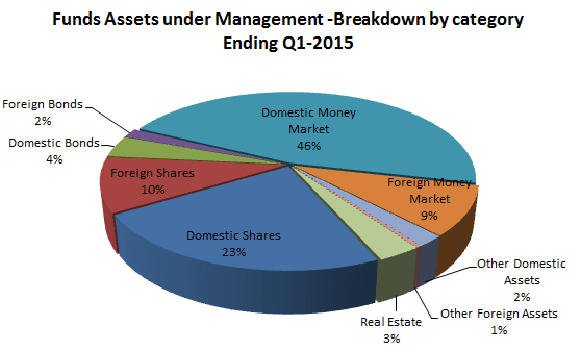
Assets of Investment funds fall under 9 types where domestic money market instruments contribute a major portion over SR52 billion or 46 percent to the aggregated value of assets. Domestic shares type assets achieve a share of 23 percent and increased by 5.71 percent by ending first quarter 2015.
In terms of objectives Saudi Investment funds are classified under four classes namely Growth Capital Growth Capital Preservation and Income. Break down by fund assets shows that Growth classified funds dominate the market with a share of 49.7 percent for assets under management at end of first quarter 2015. Income classified funds represent a share of 29.27 percent of the total AUM while Capital Preservation funds' assets a share of 18 percent only.
Mushtaq Ahmed and Tazeem Anwar are senior financial analysts at Zughaibi & Kabbani Financial Consultants.
But the number of subscriber by ending first quarter 2015 is reduced to 242802 subscribers which are lowest in ten years a decrease of 5.3 percent on YoY basis. The highest reported subscribers were 568284 at end of year 2005 onward subscribers to the Saudi investment funds reduced consecutively the Saudi Arabian Monetary Agency said in a report.
Is there a change in investors' preferences?
The reason for decline is direct access to the traders and investors for trading in local as well as in international stocks and commodities more facilities and analysis are available. Trading platforms are introduced by local brokers to trade directly in stocks in local and international markets.
However Mutual funds offer a number of advantages to investors in comparison to equity investments e.g. diversification portfolios under professional management lower entry level economies of scale and minimization of losses.
Whereas investing in equities has a risk-reward association with it. Equities are more volatile or risky and in turn offer attractive returns.
Perhaps attractive returns spurred investors to change their preferences from risk-aversion to risk-seeking.
However a significant increase in the number of Shariah-compliant funds suggests a robust demand for Islamic investing also.
'As with the broader Islamic finance industry the Islamic funds has grown to become an increasingly substantial segment within the global financial markets and has gained significant interest as a viable and efficient alternative model of financial investment' Abdul Rahman Mohammed Al-Baker executive director of Financial Institutions Supervision at the Central Bank of Bahrain (CBB) said on Monday during the 11th annual edition of the World Islamic Funds and Financial Markets (WIFFMC).
Global Islamic funds under management expected to reach $77 billion by 2019. Demand for Islamic funds projected to reach $185 billion by 2019. Malaysia and Saudi Arabia hold 69 percent of total Islamic funds under management. Sukuks and equities are the most preferred asset types for investors and asset managers projected in a Global Islamic Asset Management Outlook Report by Thomson Reuters.
The Saudi mutual fund industry is divided into Islamic Shariah-compliant and conventional types where 178 funds are Shari'ah Compliant and 78 funds are conventional. Around SR97 billion assets under management are Shari'ah compliant which equates 82 percent of the total funds assets. And SR21 billion assets under managements are conventional.
Out of these 178 Shariah-based funds managed by 40 fund managers 79 funds are globally focused and remaining 99 funds are locally focused. SR86 billion assets under management are in local market while SR10 billion assets are deployed internationally.
Segregating further 161 funds invested in stocks representing an amount of SR40.36 billion (34.29 percent of the total assets under management) where 82 funds invested in local stock while 79 invested in international stocks. Fifty one equity funds are categorized as conventional while 110 funds are Shariah compliant.
In local equity market around SR27 billion assets under management (AUM) are deployed through 82 investment funds where 24 funds with SR7.4 billion AUM and 58 funds are Shariah-compliant with SR19.7 billion assets under management.
Year-to-date (upto May 18 2015) performance of Saudi domiciled funds remains positive where 248 funds reflect an appreciation and just 8 funds show a decline. 108 funds earn a gain of above 10 percent.
Top six players are dominating a total market share of 81 percent with regards to funds' assets under management. NCB Capital is the largest asset manager in Saudi Arabia controlling assets under management amounting around SR32.3 billion. It captures 27.4 percent market share with regards to assets under management and 10 percent in terms of number of funds. Riyad Capital and SAMBA appear to be other key players holding a market share of 15.7 percent and 13.4 percent respectively. Riyad Capital managing 36 investment funds where 14 funds are Shariah-compliant and 22 funds are conventional.
Year-to-date performance of local equity Shariah-compliant funds remains positive where 57 funds reflect an increase and just 1 funds show a decrease. The highest gain in Shariah-compliant funds has been seen in HSBC Saudi Petrochemical Equity Opportunities Fund with YTD change of 28.75 percent. It is followed by Gulf Investors' DEEM Saudi Equity Fund and FACOM's Saudi Equity Fund the unit price of both increases by 27.5 percent and 25.87 percent respectively.
Year-to-date performance of Saudi conventional funds also remains positive where all 24 conventional funds reflect an increase. The highest gain in conventional funds has been seen in Morgan Stanley Saudi Equity Fund with YTD change of 27.4 percent. It is followed by EFG-Hermes Saudi Arabia Equity Fund and SAIB Saudi Equity Fund the unit price of both increases by 25.57 percent and 23.13 percent respectively.
The local equity funds which are invested in Saudi listed companies 29 funds outperformed the benchmark TASI on YTD basis where Tadawul All Share Index (TASI) increased by 17.7 percent. Furthermore 53 funds underperformed the benchmark index.
The largest Saudi domiciled fund managed by NCB under the name AlAhli Saudi Riyal Trade Fund with SR17.75 billion funds under management under category of Trade Finance Local followed by same category funds of Al-Rajhi Capital 'Al-Rajhi commodity fund-SAR' with SR12.33 billion AUM.
According to the Saudi Arabian Monetary Agency (SAMA) data for recent quarter of 2015 industry's assets under management value appreciated to SR112.35 billion an increase of 3.64 percent from the same period last year. Domestic assets are SR88.3 billion and foreign assets are SR24 billion.
Assets of Investment funds fall under 9 types where domestic money market instruments contribute a major portion over SR52 billion or 46 percent to the aggregated value of assets. Domestic shares type assets achieve a share of 23 percent and increased by 5.71 percent by ending first quarter 2015.
In terms of objectives Saudi Investment funds are classified under four classes namely Growth Capital Growth Capital Preservation and Income. Break down by fund assets shows that Growth classified funds dominate the market with a share of 49.7 percent for assets under management at end of first quarter 2015. Income classified funds represent a share of 29.27 percent of the total AUM while Capital Preservation funds' assets a share of 18 percent only.
Mushtaq Ahmed and Tazeem Anwar are senior financial analysts at Zughaibi & Kabbani Financial Consultants.

Legal Disclaimer:
MENAFN provides the
information “as is” without warranty of any kind. We do not accept
any responsibility or liability for the accuracy, content, images,
videos, licenses, completeness, legality, or reliability of the information
contained in this article. If you have any complaints or copyright
issues related to this article, kindly contact the provider above.








Comments
No comment