

403
Sorry!!
Error! We're sorry, but the page you were looking for doesn't exist.
Saudi- Govt overhauls labor law


(MENAFN- Arab News) Labor Minister Adel Fakeih announced 38 amendments to the country's labor legislation recently including more training for Saudi workers longer fixed-term contracts and greater inspection powers for ministry officials.
Fakeih thanked Custodian of the Two Holy Mosques King Salman for approving the changes which he said would boost Saudization and provide greater protection for workers and employees.
The minister said the changes would come into effect six months after they are published in the official government newspaper on the ministry's website and in the media.
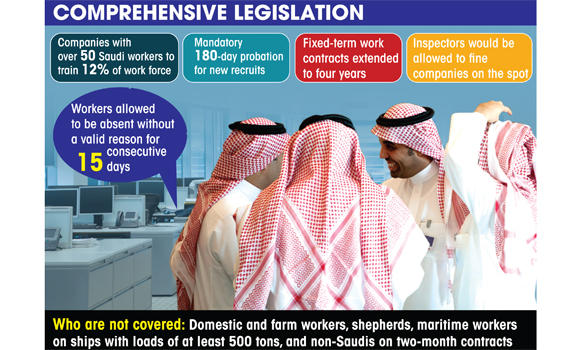
He told Arab News that companies with more than 50 Saudi workers now have to train 12 percent of their total work force rather than the previous 6 percent.
Companies must place their workers on a 180-day trial period. However if a worker leaves a company and returns after six months then he or she should go on another trial period of the same duration.
Fixed-term work contracts have now been extended from three to four years. If a contract is renewed three times in succession then it would become open-ended Fakeih told Arab News.
In addition the new amendments oblige employers not to include any comments in workers' service records that might harm or prevent them from finding work elsewhere.
The ministry requires companies to set up committees to deal with penalties imposed on workers with the approval of the ministry so that their rights are protected.
If companies fail to abide by the amendments with regard to ending the contracts of workers the ministry can close them permanently or ensure that they cannot employ such workers again.
Workers on monthly payrolls are allowed to give 60 days' notice with 30 days for those paid in a different way. They are also allowed to be absent without a valid reason for 30 non-consecutive days or 15 consecutive days.
Fakeih said the changes would require companies to pay wages to workers through bank accounts. Work hours and emergency leave including in cases of deaths in the family or giving birth were also specified under the new amendments.
Workers would have financial aid for work-related injuries extended from 30 to 60 days.
Fakeih said the amendments would allow the ministry to hire consultants to boost its inspections. Inspectors would now be allowed to fine companies immediately rather than provide advice as was previously the case.
Companies now face fines of up to SR100000 and closure for 30 days for failure to comply with certain clauses of the law or if violations are repeated.
According to reports the ministry would issue bylaws to exempt certain categories of workers from the changes including domestic workers farm workers shepherds maritime workers on ships with loads of at least 500 tons and non-Saudis on two-month contracts.
Fakeih thanked Custodian of the Two Holy Mosques King Salman for approving the changes which he said would boost Saudization and provide greater protection for workers and employees.
The minister said the changes would come into effect six months after they are published in the official government newspaper on the ministry's website and in the media.
He told Arab News that companies with more than 50 Saudi workers now have to train 12 percent of their total work force rather than the previous 6 percent.
Companies must place their workers on a 180-day trial period. However if a worker leaves a company and returns after six months then he or she should go on another trial period of the same duration.
Fixed-term work contracts have now been extended from three to four years. If a contract is renewed three times in succession then it would become open-ended Fakeih told Arab News.
In addition the new amendments oblige employers not to include any comments in workers' service records that might harm or prevent them from finding work elsewhere.
The ministry requires companies to set up committees to deal with penalties imposed on workers with the approval of the ministry so that their rights are protected.
If companies fail to abide by the amendments with regard to ending the contracts of workers the ministry can close them permanently or ensure that they cannot employ such workers again.
Workers on monthly payrolls are allowed to give 60 days' notice with 30 days for those paid in a different way. They are also allowed to be absent without a valid reason for 30 non-consecutive days or 15 consecutive days.
Fakeih said the changes would require companies to pay wages to workers through bank accounts. Work hours and emergency leave including in cases of deaths in the family or giving birth were also specified under the new amendments.
Workers would have financial aid for work-related injuries extended from 30 to 60 days.
Fakeih said the amendments would allow the ministry to hire consultants to boost its inspections. Inspectors would now be allowed to fine companies immediately rather than provide advice as was previously the case.
Companies now face fines of up to SR100000 and closure for 30 days for failure to comply with certain clauses of the law or if violations are repeated.
According to reports the ministry would issue bylaws to exempt certain categories of workers from the changes including domestic workers farm workers shepherds maritime workers on ships with loads of at least 500 tons and non-Saudis on two-month contracts.

Legal Disclaimer:
MENAFN provides the
information “as is” without warranty of any kind. We do not accept any
responsibility or liability for the accuracy, content, images, videos,
licenses, completeness, legality, or reliability of the information
contained in this article. If you have any complaints or copyright issues
related to this article, kindly contact the provider above.
Comments
No comment