

403
Sorry!!
Error! We're sorry, but the page you were looking for doesn't exist.
UK house price growth retains momentum rents decline further


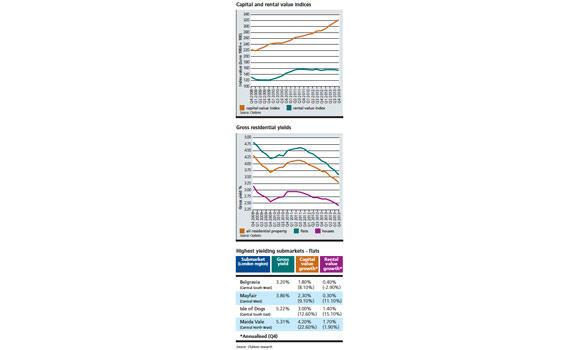
(MENAFN- Arab News) The enduring appeal of London as an investment destination has helped propel Central London capital value growth from 2.80 percent to 3.00 percent in the final quarter of 2013, taking the total increase in values this year to 12.60 percent.
This is almost twice the growth rate recorded during 2012 (6.40 percent), bringing the average property value across prime Central London to a record high of £1.70 million.
Despite the increased accessibility to debt finance, many 'reluctant renters' are still unable to attain property ownership but this has not increased rental demand.
Central London sales and lettings markets continue to diverge with net rental demand falling by 1.5 percent in this quarter, contributing to the weak 0.30 percent increase on last year.
Buy-to-let investors, fueled by the improving economic climate and motivated by poor pension prospects, are increasing the stock of rental property available, depressing rental values.
James Hyman, partner, residential sales at Cluttons UK, said: "The gradual return of bonuses has helped to fuel an upturn in the number of buy to let properties on the market in recent months, which is suppressing rental value growth rates, by boosting supply against a backdrop of weak demand.
Hyman added: "Furthermore, the improving economic climate is driving a wave of housing upgrades across London; however properties are not being recycled as owners are turning their former homes into rented properties, decreasing sales stock available and increasing pressure on values."
The report said capital value growth accelerated during the fourth quarter to 3.00 percent, from 2.80 percent during Q3, taking the total increase in values this year to 12.60 percent. This is almost twice the growth rate recorded during 2012 (6.40 percent) and the latest increase pushes the average property value across prime Central London to a record high of just over £1.70 million.
Central North West (3.80 percent), which encompasses St. John's Wood (4.70 percent), Maida Vale (4.20 percent), Hampstead (2.50 percent), Regent's Park (3.60 percent), and
Highbury & Islington (4.00 percent), was this quarter's strongest performing London region.
On a submarket level, Notting Hill (5.90 percent), in Central West, was the best performing
during Q4, with average values standing at close to £2.65 million.
The Help-to-Buy scheme has contributed to the supply dearth across London by easing access to the first rung of the property ladder to those previously locked out by the magnitude of required deposits, as was confirmed by the results of our recent survey of home purchasers who cited the scheme as a driver for the decision to purchase.
This, coupled with the persistent and arguably strengthening appeal of London as an investment destination, in the face of a rapidly improving economic backdrop, means that supply is being eroded by both domestic and international buyers.
This is to an extent reflected in the latest RICS housing market survey for London (October), which showed the balance of surveyors reporting new buyer enquiries surging to a level not recorded since April 2009.
Concurrently, new instructions have slipped back sharply once more, which is likely to translate into further upward price pressure on home values.
"The shortage of stock across the prime core is likely to result in a busier than normal Christmas period as we head toward the end of the year, with house hunters eager to commit to deals as soon as a suitable property comes to market," said the report.
Although there has been an improvement in the access to debt financing, there remains a number of 'reluctant renters' waiting in the wings as they continue to save for deposits on properties whose values continue to accelerate, pushing the homeownership dream further out of reach.
Despite this cohort of renters bolstering overall requirement levels across prime Central London, net demand remains weak and is showing signs of further deterioration as we head into the festive period. The overall weakness in the market has translated into a -1.50 percent decline in average rents across
prime Central London during Q4, leaving weekly rents at £1,007, which equates to a 0.30 percent increase on this time last year.
On a submarket level, St. John's Wood (4.00 percent) in Central North West and Surrey Quays /Rotherhithe (2.50 percent) in Central South East, were the capital's best performers in Q4.
South Kensington (-6.9 percent) in Central South West and Notting Hill (-6.7 percent) in Central West experienced the most significant declines in average rents over the same period.
With the festive period nearing, tenant activity has already started to abate, with most submarkets reporting an earlier than normal slowdown.
Whilst every effort has been made to ensure the accuracy of the data and other material contained in this report, Cluttons LLP does not accept any liability (whether in contract, tort or otherwise) to any person for any loss or damage suffered as a result of any errors or omissions.
The information, opinions and forecasts set out herein should not be relied upon to replace professional advice on specific matters and no responsibility for loss occasioned to any person acting, or refraining from acting, as a result of any material in this publication can be accepted by Cluttons LLP.

Legal Disclaimer:
MENAFN provides the
information “as is” without warranty of any kind. We do not accept any
responsibility or liability for the accuracy, content, images, videos,
licenses, completeness, legality, or reliability of the information
contained in this article. If you have any complaints or copyright issues
related to this article, kindly contact the provider above.
Comments
No comment